
Cricket In Rural Sri Lanka
How I learned to find meaning in the unexpected

Humans are flawed, and we rarely know for certain what’s best for us. Most of you reading this right now are probably nodding internally in agreement with this statement—and yet next time the unexpected and unwanted intrudes on your well-laid plans, I bet you will resist it and rigidly course-correct with everything in you.
I want to tell you two things today. I want to tell you a short story about a long afternoon I spent lost in Sri Lanka—and I want to tell you how it changed the places I look to find meaning.
From my journal:
“It’s ridiculous how I just can’t write in this journal everyday—it really shouldn’t be that hard and yet I always fail. There is so much to tell. First of all, on March 5th I had one of those magical experiences which remind me why I love travel.”
My trip up to this point had taken me to Rock View Hostel in Ella, Sri Lanka. I knew I wanted to spend a week or so in Ella, but I was in one of those backpacking lulls where I didn’t really have anything specific on the immediate agenda, and I was asking around, doing some research on what my next little outing should be.
I eventually decided on going to see Lipton’s Seat, a beautiful scenic overlook about an hour-and-a-half’s motorcycle journey away from the hostel. Little did I know I would never make it to Lipton’s Seat, but would end up somewhere much, much better—a place that, at the time, didn’t even exist in my sphere of awareness.
Around 4 pm, I set out on my motorcycle (it was really an automatic moped, but motorcycle sounds much cooler, so I’m just going to go with that). My phone was only at around 50% battery, which, if you know me, is actually shockingly high. It was March, and I knew the sun set at around 6:30, which meant the last part of the return journey would likely be in the dark, but that was fine. My motorcycle had a headlight, after all.
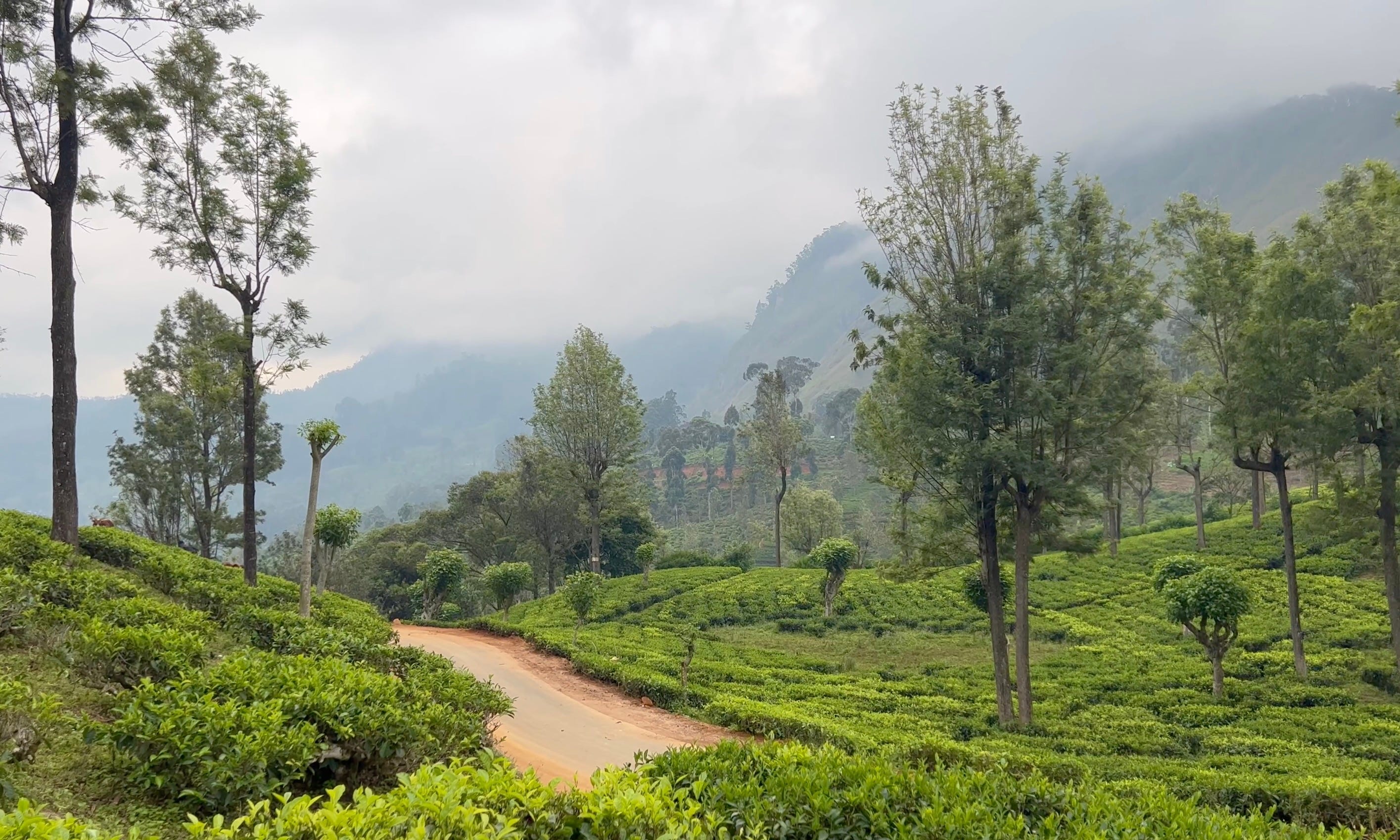
Ella is high up in the mountains, and so it was actually pretty cold. As I drove, my surroundings slowly morphed from urban to rural. The bustling roadside shops and buildings all disappeared, replaced by a seemingly endless landscape of terraced tea fields, so vibrantly green as to be almost jarring.
Somewhere along the way, I made a wrong turn. Thinking back now, I’m not sure if I was too busy staring at the scenery, if my phone just lost internet for a bit, or what. I know I had the journey routed on Google Maps, but I’m so directionally challenged that no route is truly Robbie-proof—so I’m not surprised this happened.
I’m sure I spent a considerable period of time looking back and forth between the road and my phone, watching as Google struggled to calibrate my location and make a correction.
At a certain point, with the sky becoming ever more overcast and the white afternoon sunlight transitioning to that deeper yellow shade that always accompanies the sunset, it dawned on me that I was not going to make it to Lipton’s Seat with enough daylight left to fully appreciate the view—which was the only reason to go to Lipton’s Seat in the first place. I decided to just reverse course and head back to Ella.
If I had never made that wrong turn—if I was actually able to follow directions, and if Google Maps had done its job and generated a new route for me—then I’m almost certain this little escapade would never have made it into my travel journal, and I would not be sitting here racking my brain, trying to recall every last detail that would make the next few hours so magical.
The fields which surrounded me became progressively more stunning. I mean, just everywhere I looked, there were rolling fields of these green tea leaves, basically as far as the eye could see. I would round a bend in the road only for an even more majestic range of hills to sweep into view. The air was crisp and fresh, and I’m almost certain my eyes were watering from the breeze, the way they do when you’re skiing without goggles. The sky was crowded with dark clouds, but not so crowded that there was no sunlight. Yellow rays poked through here and there, lending a surreal, dreamlike quality to the whole scene.
Honestly, as I think back to those moments now, they feel almost ethereal. But is that due to the quality of the day itself as it actually was in reality, or the inevitable garnishes of memory, the embellishments our brains automatically layer on top of core experiences? And is there even an important difference between the two?
After some undefined length of time just lost in this new world, I rounded another bend and came across something unexpected: A group of about 15 Sri Lankan villagers—kids, adults, and old men—playing a game of cricket smack in the middle of a wide section of road.
From the way they looked at me, it seemed pretty clear that the occasional passing vehicle was a normal occurrence—for that vehicle to be driven by a white man was very rare indeed. After a moment’s indecision I slammed on the brakes and climbed off the motorcycle, which was ticking as it cooled.
I was soon completely surrounded, likely trying out every piece of Sinhalese I had learned so far. I like to think I was having broken conversations with them, but in reality, I was probably just saying “Ayubowan” (hello) over and over again while smiling like an idiot.
The kids, of whom there were probably five or so, were just staring at me unabashedly, as if I was some unknown entity about which they knew nothing—and actually, that was probably exactly what I was.
The best part of the whole encounter, though, was the overwhelming feeling of being welcome. Yes, I was an unknown entity—but I was an entity they liked, and they did not hesitate to show it. I kid you not, I’ve felt more uncomfortable walking into stores 15 minutes away from the house I grew up in than I did mingling with this random group of villagers halfway across the world.
In particular, I remember one old man shaking my hand, pointing at me, and repeatedly saying, “I like you!” but in his broken English it sounded more like, “I yike yoo!” He was smiling ear-to-ear the entire time.
I forget if they invited me to join the game of cricket, or if I asked them—but given all my experiences with Sri Lankans, I’m almost certain it was the former.
I stepped up to bat and, being an American who had played baseball as a kid, took an absolutely massive crack at the first pitch I got, not realizing that in cricket, where you hit the ball is much more important than how far. The ball was absolutely rocketed into right field, and the caveman in me is still proud of that, even though I was promptly declared “out” and had to step out of play.
In those moments, did it even dawn on me how much better this was than making it to Lipton’s Seat and seeing just another scenic overlook? Did I realize that over two years later, I’d be sitting in a coffee shop in California, writing an entire blog post about this little “mishap” of a day?
I don’t think so. And the reason I don’t think so is that I left those villagers way too soon in my quest to get back to my hostel.
To be fair, I think at this point my phone was almost dead, and the task of navigating back to the city of Ella was feeling more challenging by the moment—but knowing what I know now, and thinking back to that magical convergence of fates, I wish so badly that I had said “screw it” and finished that game with them. I’m almost certain I would have been invited back to someone’s house for dinner and hot tea afterward.
My phone did die, and I did make it back to my hostel—but I had to do it the old-fashioned way: reading signs and stopping every 10 minutes to ask a random person for directions.
Often, meaning is found most readily in the unexpected, the unknown, and the inconvenient. This is a skill that can be learned—but it can’t be learned the same way other skills can.
Becoming proficient in most skills is a simple matter of increasing your knowledge of the thing the skill pertains to. But the very point of this skill is that these potential moments of deep meaning will come upon you without you knowing they will. Mastery here necessitates a peace with your own ignorance; an ever-present willingness to abandon your well-laid plans at a moment’s notice.
And most of all, it demands from you a belief that the unknown which happens next just might be better than the known you’ve been hoping for.
Make yourself believe this next time something goes irreversibly wrong, and you’ll be pleasantly surprised. I’m sure of it.