
5 Thoughts On "A Christmas Carol"
A challenge to be less like the bad Scrooge and more like the good one

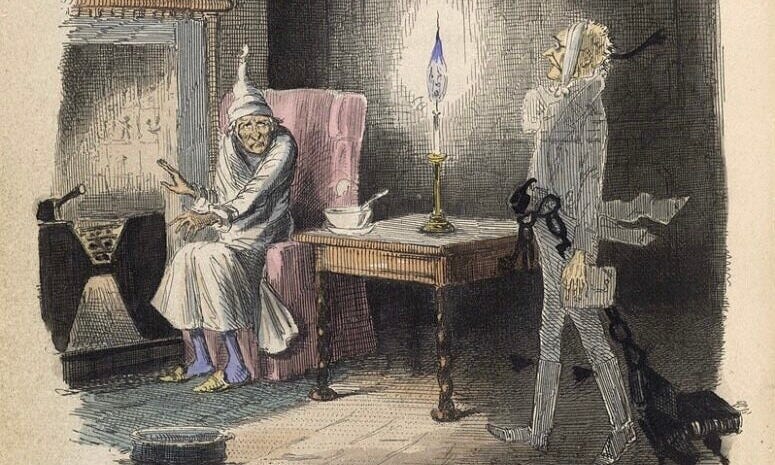
I recently watched Disney’s “A Christmas Carol” for probably the 10th time, while embarrassed to say I still have yet to read the original book. Throughout the course of the movie, I was so profoundly moved that I had to go retrieve my journal and put my thoughts into writing.
Here they are, in order of importance.
1. Bob Cratchit and Scrooge’s nephew don’t hate Scrooge—they feel sorry for him
“Oh, I have!” said Scrooge’s nephew. “I am sorry for him; I couldn’t be angry with him if I tried.
“Mr. Scrooge!” said Bob; “I’ll give you Mr. Scrooge, the Founder of the Feast!”
At first blush, this seems like just another iteration of the whole “love your enemies” trope—but I would argue it’s not. Loving your enemies, while undoubtedly remarkably difficult, has a sense of nobility, of honor, attached to it. If you can only bring yourself to do it, most people will probably admire and respect you for it.
But throughout “A Christmas Carol,” it’s pretty clear that Scrooge is not the enemy of his nephew or of Bob Cratchit in any real sense. He’s not trying to kill them, and he doesn’t hate them with any special vitriol he withholds from everyone else. No, Scrooge is not their enemy—he’s just obnoxious and cruel and bitter.
Curiously, I often find it harder to stop hating these types of people than to stop hating the actual avowed enemies of my family or country.
Think about it: When you’re in a circle with your close friends and you’re just bashing on somebody, who is it usually? Is it some government official in a foreign country who’s plotting the destruction of your country? Is it a genuinely malevolent person who would kill you if they could? Or is it just that one unremarkable “friend” who cares about nothing but himself, who finds something new to be cynical about every minute of every day?
The motivating insight that Bob Cratchit and Scrooge’s nephew both share is that selfishness and cynicism almost always hurt the perpetrator more than the victims. As Scrooge’s nephew says, “Who suffers by his ill whims! Himself, always.”
It’s startling how in a movie like “A Christmas Carol,” our eyes can well up with tears at Bob Cratchit’s selfless toast to Scrooge as “the Founder of the Feast,” or Scrooge’s nephew’s heartfelt invitation for Scrooge to attend his dinner party, and yet so brazenly ignore every opportunity we get to do the same for the pitiful, miserable Scrooges in our own lives.
2. Scrooge says Mrs. Dilber is the loveliest creature he’s ever laid eyes on—and she’s hideous
Okay, this one is not in the book—only the Disney movie. I’m going to comment on it anyway, even though I know this will seriously diminish my ideal image as a mature lover of the classic works.
After his epiphany with the three ghosts, Scrooge runs into his maid, Mrs. Dilber. In the movie, she’s portrayed as monumentally ugly: crossed eyes, huge nose, pimpled skin, and missing teeth. She looks smelly, dirty and sick.
And yet, when Scrooge sees her he says, “My dear Mrs. Dilber, you’re the loveliest creature I have ever laid eyes upon.” And he grabs her and tries to dance with her! Something he’d experienced on his journeys with the ghosts brought it home to him that physical appearance and hygiene have absolutely nothing to do with a person’s worth.
But this is obvious, right? I’m sure every person reading this post right now, if asked a question to that effect, would answer wholeheartedly exactly as I have above. And yet… do we live our lives in this way?
To find out, I propose a simple test. Next time you interact with someone who looks (and smells) the way Mrs. Dilber does in the movie, pretend they don’t look that way. Pretend they’re beautiful (or handsome), clean, articulate, smelling of cologne, with shining white teeth, and ask yourself: “Would I interact with that person the same way I’m interacting with this person right now?” I’m almost certain the answer will be a resounding “No.”
Of all the instinctual urges present within myself, I find this one to be among the most utterly detestable.
3. Scrooge talks to beggars
When Scrooge leaves his house after his fateful night and walks down the street, Dickens says that he “questioned beggars.”
I’d wager that, even though heroin and fentanyl were likely not present in 1843 London, these beggars were quite similar to the many homeless we encounter in the 21st century, in that they were, for whatever reason, unable or unwilling to simply find a job and make an honest living, probably often due to personal failings or addictions—not mere helpless circumstance.
With this very specific language of saying that Scrooge “questioned beggars,” Dickens denies us the get-out-of-jail-free card of “Well, I’d give them money but they’ll just use it on drugs.” We can instead give them our time and our interest.
And, speaking from personal experience, a genuine five-minute conversation can provide a homeless person with far more meaning and happiness than five hundred-dollar bills.
Some people are really and truly alone in this world. Every day that you leave your house, you carry with you the tremendous power to change that—for free. Why not use it?
4. Scrooge finds beauty in everything
“He went to church, and walked about the streets, and watched the people hurrying to and fro, and patted children on the head, and questioned beggars, and looked down into the kitchens of houses, and up to the windows, and found that everything could yield him pleasure. He had never dreamed that any walk—that anything—could give him so much happiness.”
Obviously, Scrooge was incapable of this type of gratitude and wonder before his ordeal. If you told him to try it, he would scoff at you. It was only through his tumultuous night with the three ghosts and the perspective he gained through it, that he became capable of this. If we went through the same things Scrooge went through, we’d probably come out the other side with a renewed vigor for life as well.
But if you’re like me, and your eyes fill up with tears at the beauty of “A Christmas Carol” every time you read it or watch it, you don’t actually have to go through something like this in order to gain Scrooge’s transcendent outlook—you can just read the story.
This is the wonder of the creative work, of inspiration, of the putting of the pen to paper and the spinning of a marvelous tale. Pretend you’re Scrooge. Pretend the ghosts showed all those very same things to you. Think of all the ways your life could be immeasurably worse than it is now, and just how trivially easy it is to live the small moments of your life in a way that is above reproach—and then walk the main street of your neighborhood and tell me everything doesn’t “yield you pleasure,” as Dickens puts it.
And if that isn’t doing it for you, you can actually put yourself through an experience similar to that which Scrooge went through. Just go visit a third-world country.
I’m serious—it’s actually kind of that simple.
5. Sorrow moves us (or at least, me) more than joy
Finally, stepping outside of the story itself, as I watched the movie I found it remarkable just how much more moved I was by the sorrowful moments than the joyful ones.
Sure, the final payoff of the changed Scrooge is what gives the story its actual cash value—but throughout the movie, I found my heart most intensely provoked during the sad scenes.
And the one in particular that serves as the perfect microcosm of this point is the following:
“As good as gold,” said Bob, “and better. Somehow he gets thoughtful, sitting by himself so much, and thinks the strangest things you ever heard. He told me, coming home, that he hoped the people saw him in the church, because he was a cripple, and it might be pleasant to them to remember upon Christmas Day, who made lame beggars walk, and blind men see.”
Speaking from pure emotion, there seems to be such a rich beauty in the promise of redemption from suffering and sorrow. Could it be possible that a world with profound suffering that is then vanquished, is actually better than a world that never had that suffering in the first place?
My mind says no—but my heart says maybe.
Summary: Fiction is not fiction
As a romantic and a dreamer, I erect no walls between the themes I experience in movies and books, and the themes I’d like to see play out in my own life.
When my on-screen hero does something remarkable—when they choose love instead of hate, when they lift up the lowly, when they find beauty in the mundane—I want to see that become a reality in my own life and in the lives of those around me.
I think one of the reasons Christmas moves me so profoundly is that it’s one time of year when almost everyone can agree on that.
This Christmas, I challenge you to make that sentiment play out in your deeds as well as your words.
Loved these thoughts.
I’ve always thought the Christmas Carol was the best Christmas movie!!! Well done Rob. This was both deep and informative as always.